What Is an AI Growth Agent? Autonomous Growth for Subscription Apps, Explained
July 5, 2026 · 3 min read

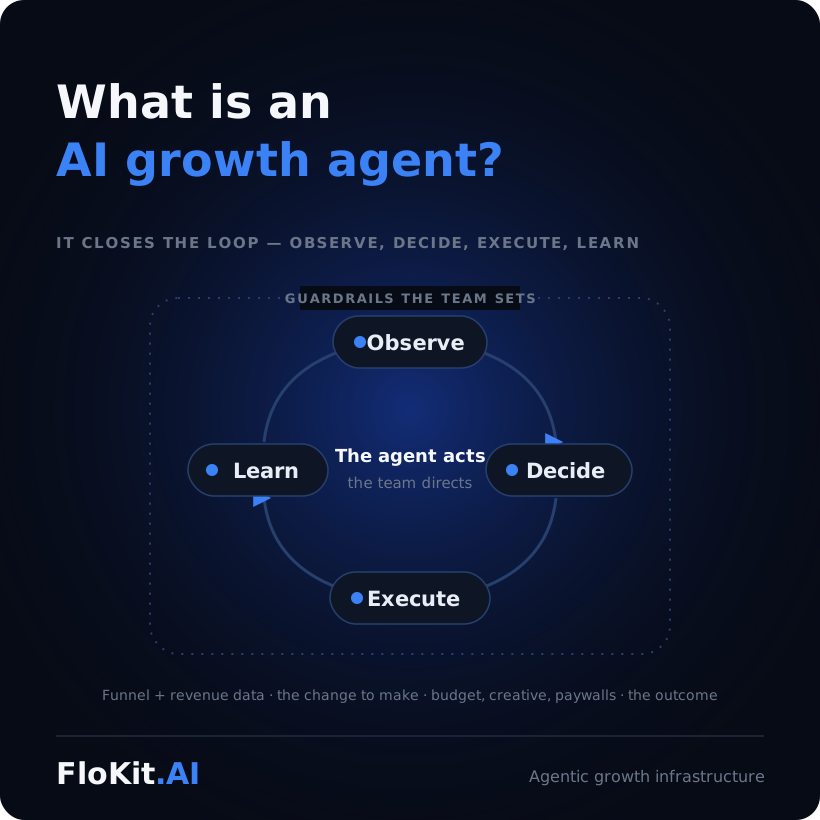
An AI growth agent is software that runs part of your growth loop autonomously: it observes funnel and revenue data, decides what to change, executes the change on the live channel or product surface, and learns from the result. Where an AI feature suggests and a dashboard reports, an agent acts, shifting acquisition budget, rotating creative, adjusting a paywall test, within guardrails a human team defines. It is the difference between software that helps you operate growth and software that operates growth for you.
Agent vs. AI feature: the loop is the difference
Most "AI-powered" growth tools add a model to one step of a manual workflow: they score a creative, draft ad copy, or predict churn, and then hand the decision back to a human queue. An agent closes the loop. It owns a goal (say, payback within a target window), watches the signals that feed it, makes the change itself, and reads the outcome to inform the next move. The test is simple: if the software stops working when your team stops logging in, it’s a feature. If growth work continues, observed, decided, executed, measured, it’s an agent.
What growth agents actually do today
In consumer subscription apps, the work agents already handle clusters around four jobs. First, acquisition budget management: moving spend out of underperforming campaigns and creatives toward cohorts with stronger return on ad spend and retention, continuously instead of in weekly reviews. Second, creative rotation: detecting fatigue and swapping variants before performance decays. Third, monetization testing: running paywall placement, trial length, and price experiments at a cadence no coordination-heavy team achieves manually, which matters because most of the conversion decision happens in the first session. RevenueCat’s industry data shows 55% of 3-day trial cancellations happen on Day 0; a system that reacts weekly is reacting after the verdict. Fourth, value-based bidding: feeding real cohort lifetime value back into acquisition, so bidding optimizes for retained revenue instead of installs.
Why agents are arriving now
Three pressures converged. Paid acquisition got more expensive as auctions grew more competitive and privacy changes blurred attribution signal, stretching payback windows. Discovery fragmented, app stores, short-form video, and now AI answer engines, faster than growth teams can re-tool. And the levers that most directly determine revenue, paywalls and pricing, are still tested a few times a year in most apps because every test crosses half a dozen disconnected tools. Human-speed optimization against machine-speed auctions is a losing trade; agents exist to close that gap.
What an agent should never do
Autonomy without guardrails is a liability, not a product. A credible growth agent operates inside explicit constraints: spend caps and pacing limits, approval gates for high-risk changes like price moves, full audit logs of every action taken and why, and instant rollback. The team sets direction and boundaries; the agent does the work inside them. Any vendor that can’t show you the guardrail model before the autonomy demo has the priorities backwards.
How to evaluate an AI growth agent
Six questions separate real agents from rebranded automation. What does it observe, does it see your whole journey (acquisition cost through trial, conversion, retention, and LTV), or one channel in isolation? What can it actually execute, on which ad networks and product surfaces? What objective does it optimize, installs are easy, retained revenue is the point? What are the guardrails, caps, approvals, audit, rollback? How does it learn, does outcome data demonstrably change its next decision? And how does it handle attribution noise, confident action on bad signal is worse than no action at all.
Where this is heading
The likely end state is not a smarter dashboard but a growth operating system: one agentic layer that connects acquisition, creative, conversion, pricing, retention, and LTV around a single view of the user journey, with humans directing strategy and reviewing the moves that matter. That is the thesis FloKit.AI is built on, an agentic growth OS for consumer subscription apps, with autonomous acquisition at its core. Whoever you evaluate, hold them to the standard above: a real agent closes the loop, shows its work, and leaves you in control.