From Dashboard to an Agentic Growth OS
July 19, 2026 · 4 min read

Growth teams do not need another dashboard. They already have dashboards for spend, attribution, product analytics, subscriptions, experiments, and retention. The problem is not a lack of charts. The problem is that every chart ends with the same burden: a person still has to work out what changed, why it happened, whether it matters, and what to do next.
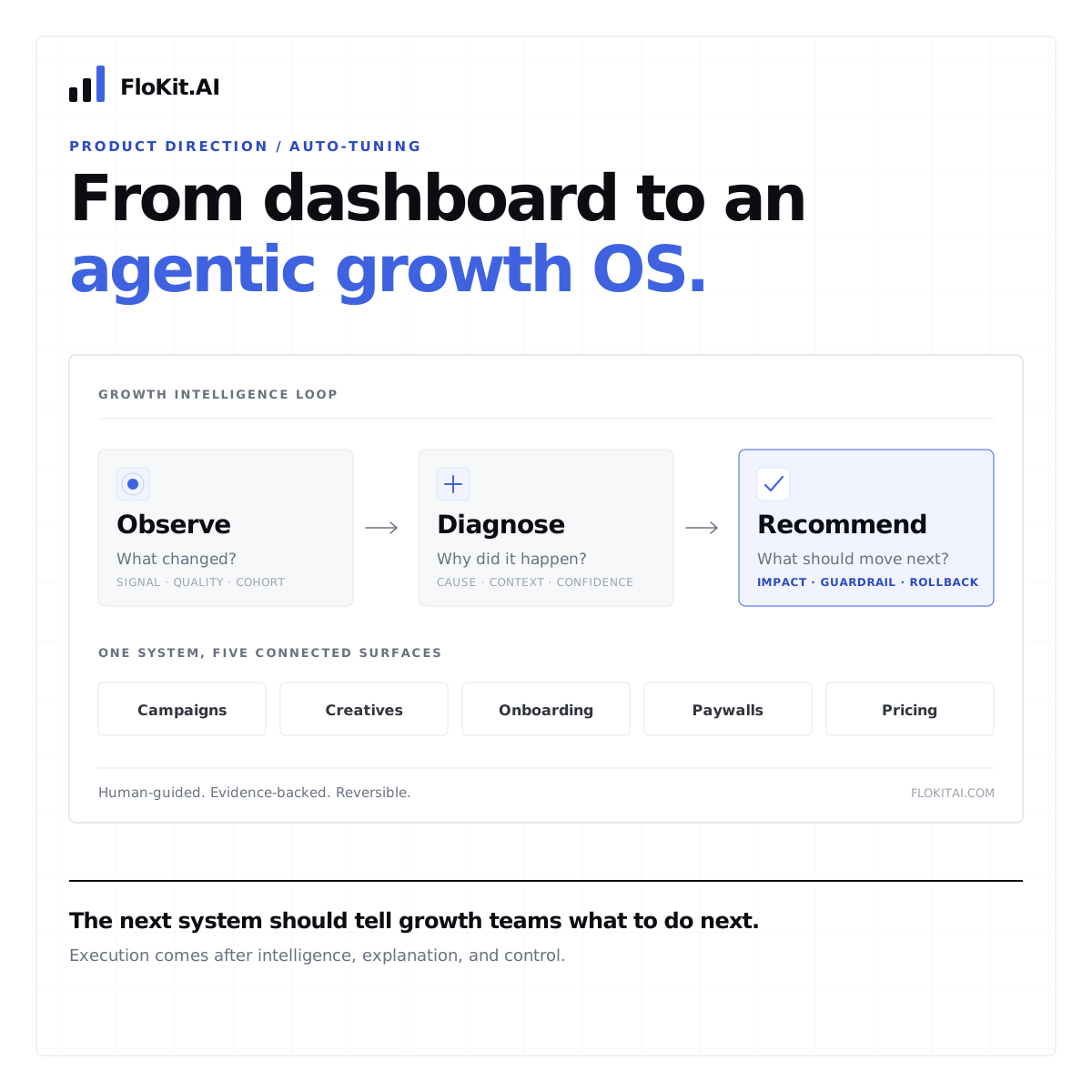
The shift that matters is a move from reporting software to a growth decision system. The path is simple to describe: Observe → Diagnose → Recommend. Execution is only as safe as those three layers are trustworthy.
Observe the journey, not isolated metrics
A useful growth system must see more than campaign performance. It needs to connect the campaign and creative that brought a user with the onboarding path they experienced, the paywall and offer they saw, the price they accepted or rejected, and the revenue quality that followed. Otherwise, the system can tell you which campaign produced the cheapest install while missing that another campaign produced the customers who actually stayed and paid.
Observation also needs context. A change in conversion rate means something different after a new creative launch, a pricing presentation update, a traffic-mix shift, or a broken event integration. The first job of intelligence is to establish what changed, where it changed, and whether the underlying signal is complete enough to trust.
Diagnose before prescribing
Most dashboards stop at correlation: this line went down while that line went up. A diagnostic layer should go further. Did conversion decline because a creative attracted lower-intent traffic? Did a campaign look efficient because revenue arrived outside the attribution window? Did onboarding improve activation but send fewer users to the paywall? Did a paywall lift first transactions while reducing renewal quality?
The answer will not always be certain, and the system should say so. Good campaign intelligence distinguishes measured evidence from inference, shows the competing explanations, and waits when the sample is too small. A confident answer built on stale or incomplete data is more dangerous than no answer at all.
Recommend a bounded next move
Once the system understands the change, it should propose the next action in operational terms. Move a controlled amount of budget toward the campaign producing stronger downstream revenue. Rotate a fatigued creative. Create a source-specific onboarding or paywall variant. Test a different offer presentation. Hold steady because the campaign is still learning.
Every recommendation should show four things: the evidence behind it, the expected impact, the level of confidence, and the rollback path. This turns “AI says so” into a decision a growth operator can inspect. It also makes execution safer, because the system knows not only what it wants to change, but how to reverse the change if the outcome is worse.
Campaigns, creatives, onboarding, paywalls, and pricing are one system
Growth software is usually organized by category. The user journey is not. A campaign makes a promise. The creative frames that promise. Onboarding proves it. The paywall packages it. Pricing asks the user to value it. Optimizing any one of these surfaces without the others can create a local win and a global loss.
This is why auto-tuning should not mean a faster campaign bot. It should mean a shared intelligence layer that can reason across the connected surfaces. If a creative brings more clicks but lower-quality subscribers, the answer may be to change the creative, not increase budget. If a strong campaign underperforms only at a mismatched paywall, the answer may be a new paywall variant, not a campaign cut.
Auto-tuning sometimes means slowing down
An intelligent system should not make a change simply because it can. Ad platforms have learning phases. Subscription outcomes mature over time. Low-volume campaigns produce noisy results. Too many simultaneous edits destroy the ability to understand what caused the next result.
A credible auto-tuning loop respects those constraints. It waits for enough evidence, protects learning periods, changes one bounded variable when attribution matters, and keeps a record of the before state. The goal is not maximum activity. The goal is better decisions at the right cadence.
Intelligence first. Recommendation next. Execution last.
The safest path to autonomy is staged. First, the system observes and explains. Then it recommends actions for human approval. Later, low-risk actions can run inside explicit spend limits, traffic limits, approval policies, and kill switches. Pricing, major budget moves, and other consequential changes remain approval-gated until the evidence and operating model justify more autonomy.
This is how FloKit.AI works: an agentic growth layer for consumer subscription apps that connects campaign performance, funnel behavior, conversion, and monetization quality. It tells the team what to do next, shows its reasoning, and executes the parts the team has delegated, inside explicit limits and approvals.
That is the shift from a dashboard to an agentic growth OS: not more information to monitor, but a controlled learning loop that helps the team make the next move.